The Third Law of Thermodynamics states that it is impossible to reach absolute zero in a finite number of steps. A shortcut way to remember the law is "you cannot leave the game." An alternate shortcut to remember the law is "let's keep score" which is based on the fact that the third law provides the foundation for thermodynamic temperature scales.

Showing posts with label Units. Show all posts
Showing posts with label Units. Show all posts
Sunday, January 22, 2012

Sunday, October 30, 2011
Time's Arrow
This post is part of a series, Nonsense and the Second Law of Thermodynamics. The previous post is entitled The Second Law, Microscopic Reversibility, and Small Systems. The previous post is essential to understanding this post.
Why does time move forward instead of backward? In the spatial dimensions, one can move left or right, up or down, backward, or forward.

Time, on the other hand, has a preferred direction. Why is that so? The underlying physics does not seem to have a preferred direction, but time does.
Why does time move forward instead of backward? In the spatial dimensions, one can move left or right, up or down, backward, or forward.
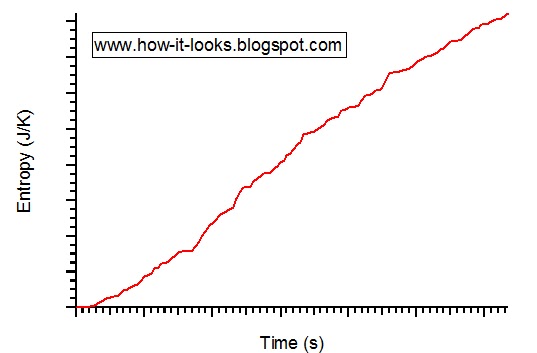
Time, on the other hand, has a preferred direction. Why is that so? The underlying physics does not seem to have a preferred direction, but time does.
Saturday, July 9, 2011
Petagrams of Carbon
Sometimes carbon dioxide is referenced in units of ppm, and sometimes it is referenced in petagrams of carbon. What are the meanings of these units and how does one convert between them?

In a previous post I explained how to convert to and from units of ppm. The current post explains the units petagrams of carbon, and how to convert from ppm to petagrams of carbon.

In a previous post I explained how to convert to and from units of ppm. The current post explains the units petagrams of carbon, and how to convert from ppm to petagrams of carbon.
Saturday, May 7, 2011
Enthalpy
This post continues a tangent from my series on the second law of thermodynamics. It discusses another quantity in thermodynamics, but it is necessary before I can get to the next post in the series, which is on free energy.
This post discusses the term enthalpy.

At constant pressure the change in enthalpy is the heat transferred to a system.
ΔH = q at constant pressure.
Heat is not a state function, but enthalpy is.
This post discusses the term enthalpy.

At constant pressure the change in enthalpy is the heat transferred to a system.
ΔH = q at constant pressure.
Heat is not a state function, but enthalpy is.
Sunday, March 27, 2011
Converting Units of Temperature
In the course of writing articles for this blog, on occasion I write a post on the conversion of units. Units can be confusing for some, and if I can add some clarity, I think it is worth doing. This post addresses conversion between units of temperature.
The most common temperature conversion that one wants to do is to convert degrees Celsius to degrees Fahrenheit or vice versa. I hope to explain how to do this conversion in such a way that one need not memorize a formula, even to get the exact answer.
First, it is worthwhile to mention a quick and dirty approximation that almost anyone can do in his or her head. It is not exact, but it is useful, if you are traveling to a country that uses a scale that is different than the one you use to think about ambient temperatures.

The most common temperature conversion that one wants to do is to convert degrees Celsius to degrees Fahrenheit or vice versa. I hope to explain how to do this conversion in such a way that one need not memorize a formula, even to get the exact answer.
First, it is worthwhile to mention a quick and dirty approximation that almost anyone can do in his or her head. It is not exact, but it is useful, if you are traveling to a country that uses a scale that is different than the one you use to think about ambient temperatures.

Friday, January 14, 2011
Temperature Anomalies and Graphing Data
Globally Averaged Temperature Anomaly
One statistic that is used to understand climate is the annual globally averaged temperature anomaly. It is not the only measure of global warming; there are a great many others, but it is one that the media tend to focus on because it is a convenient way of explaining what is happening to surface temperatures as a function of time.
 The data here are taken from Global Land-Ocean Temperature Index (C) (Anomaly with Base: 1951-1980), which includes data from 1882-2007. There are updated numbers available for more recent years, but I am using these data to respond to an argument made by a friend.
One statistic that is used to understand climate is the annual globally averaged temperature anomaly. It is not the only measure of global warming; there are a great many others, but it is one that the media tend to focus on because it is a convenient way of explaining what is happening to surface temperatures as a function of time.

Saturday, November 6, 2010
Entropy and Statistical Thermodynamics
This post is part of a series, Nonsense and the Second Law of Thermodynamics. The previous post is entitled The Second Law and Swamp Coolers.
A previous post discusses the macroscopic thermodynamic definition of entropy, but there is another, statistical way of describing entropy. Consider an isolated macroscopic system of interacting molecules. Without knowing much about what is going on with the individual molecules, it is possible to measure macroscopic thermodynamic properties such as the pressure, the temperature etc.

(Figure Source)
Consider that the system is isolated; so that the total energy of the entire system of molecules is a constant. Energy is free to move from one molecule to another, and each molecule has multiple electronic, vibrational, rotational, and translational energy states that it could be in. There are many distinguishable ways that the system could be arranged to achieve the this energy.
A previous post discusses the macroscopic thermodynamic definition of entropy, but there is another, statistical way of describing entropy. Consider an isolated macroscopic system of interacting molecules. Without knowing much about what is going on with the individual molecules, it is possible to measure macroscopic thermodynamic properties such as the pressure, the temperature etc.


Consider that the system is isolated; so that the total energy of the entire system of molecules is a constant. Energy is free to move from one molecule to another, and each molecule has multiple electronic, vibrational, rotational, and translational energy states that it could be in. There are many distinguishable ways that the system could be arranged to achieve the this energy.
Saturday, October 9, 2010
The Definition of Entropy
This post is part of a series, Nonsense and the Second Law of Thermodynamics. The previous post is entitled: The Carnot Cycle. This post is heavily dependent on the previous post; so I recommend reading it first.
Let q represent the heat transferred in a process, and qrev represent the heat transferred in a reversible process. Let T be the absolute temperature (in Kelvin).
The sum of qrev/T for all steps of the process over a full Carnot cycle is equal to zero. In fact, it is true for any reversible cyclic process.

Let q represent the heat transferred in a process, and qrev represent the heat transferred in a reversible process. Let T be the absolute temperature (in Kelvin).
The sum of qrev/T for all steps of the process over a full Carnot cycle is equal to zero. In fact, it is true for any reversible cyclic process.

Saturday, September 25, 2010
Nonsense and the Second Law of Thermodynamics
Introduction
The Second Law of Thermodynamics is, perhaps, the most abused physical law of all time. It may be rivaled for that distinction by the Uncertainty Principle, Relativity, and Hawking Radiation, but I think the Second Law probably wins the contest.
There is a plethora of nonsense disseminated on the web and elsewhere that misrepresents what the law actually says. This series is an attempt to curb some of that nonsense. Along the way, I hope to make some sense of what the second law of thermodynamics actually does say, as well as addressing some of the nonsense that people believe about it.

The Second Law of Thermodynamics is, perhaps, the most abused physical law of all time. It may be rivaled for that distinction by the Uncertainty Principle, Relativity, and Hawking Radiation, but I think the Second Law probably wins the contest.
There is a plethora of nonsense disseminated on the web and elsewhere that misrepresents what the law actually says. This series is an attempt to curb some of that nonsense. Along the way, I hope to make some sense of what the second law of thermodynamics actually does say, as well as addressing some of the nonsense that people believe about it.

Friday, July 30, 2010
How To Convert To and From Parts-Per-Million (ppm)
Parts-per million (ppm) is a common quantity used in many areas of math and science. It can be somewhat difficult for some to understand because it is not a true unit. In fact, ppm is a unitless quantity. It is analogous to percent. Percent can refer to just about anything. Percent means part-per-hundred, per cent (cent meaning hundred). ppm is an exactly analogous quantity, but it is one part per million instead of one part per hundred. ppm is a ratio between two numbers that have the same units. Consider the example of a 5% sales tax. For every hundred dollars I spend, I must pay 5 dollars in sales tax. So:
5 dollars/100 dollars = 5%
I would much rather pay a 5 ppm sales tax:
5 dollars/106 dollars = 5 ppm
We do not usually refer to money in ppm, but we could. Ppm is more often found as a concentration, for example, ppm by mass or ppm by volume (sometimes referred to as ppmv). In nuclear magnetic resonance spectroscopy ppm can be used to describe the amount of chemical shift in frequency (Hz/MHz). This post focuses on the use of ppm as a measure of concentration.

5 dollars/100 dollars = 5%
I would much rather pay a 5 ppm sales tax:
5 dollars/106 dollars = 5 ppm
We do not usually refer to money in ppm, but we could. Ppm is more often found as a concentration, for example, ppm by mass or ppm by volume (sometimes referred to as ppmv). In nuclear magnetic resonance spectroscopy ppm can be used to describe the amount of chemical shift in frequency (Hz/MHz). This post focuses on the use of ppm as a measure of concentration.

Friday, July 9, 2010
How To Convert To and From Wavenumbers
The question of how to convert from one set of units to another comes up from time-to-time, and I think it might be helpful to have a few short posts that simply address unit conversion. This post addresses conversion to and from wavenumbers (cm-1) (also called reciprocal centimeters, inverse centimeters or Kaisers). A previous post What is Infrared Radiation (IR)? addresses the concepts behind this unit. The unit is proportional to frequency, and can be considered a unit of frequency or of energy.


Saturday, January 23, 2010
What is Infrared Radiation (IR)?
This post is part of a primer on infrared spectroscopy and global warming. The main post gives an overview of the topic and provides links to each of the sections. This post examines what infrared radiation (IR) is, a necessary first step to understanding the importance of IR in discussions about global warming.

Figure source
IR is a type of electromagnetic radiation; so the starting place is to understand electromagnetic radiation.

Figure source

IR is a type of electromagnetic radiation; so the starting place is to understand electromagnetic radiation.
Thursday, January 14, 2010
The Beer-Lambert Law
Introduction
This post is part of a primer on infrared spectroscopy and global warming. The previous post looks at the features of the spectra of molecules of interest molecules and radiation and discusses how molecules give rise to infrared spectra. This post looks at the question of how much radiation is absorbed by gas phase molecules in a laboratory setting and examines some of the differences between the laboratory gas cell and the earth's atmosphere.

This post is part of a primer on infrared spectroscopy and global warming. The previous post looks at the features of the spectra of molecules of interest molecules and radiation and discusses how molecules give rise to infrared spectra. This post looks at the question of how much radiation is absorbed by gas phase molecules in a laboratory setting and examines some of the differences between the laboratory gas cell and the earth's atmosphere.

Subscribe to:
Posts (Atom)